
AI First Has a True Core. Usually It Is Not the AI
Picture the leadership team declaring AI First. Every department is told to go through its processes and mark where a model can help. A few weeks later a list
Picture the leadership team declaring AI First. Every department is told to go through its processes and mark where a model can help. A few weeks later a list lands on the table, and strikingly many steps carry the same note: we have no clear process here, a model would not help much.
What follows for a slogan that starts with AI? My position: AI First has a true core, namely the occasion to look at every process again. The bigger win is the outcome of that audit: a better process in which as much as possible runs on fixed rules. AI works where a model has a real advantage, and it can still help you find and build the rule-based part.
As a strategy, AI First is blurry to me. As a reason for an audit it is valuable, because under that label money suddenly exists to look everywhere. A label that opens budgets and then becomes an end in itself is a pattern we have seen before, in the reengineering wave of the 1990s. In 1990 Michael Hammer argued that you should not speed up processes with IT but redesign them ("Don't Automate, Obliterate").1 Thomas Davenport, by his own account one of the people who shaped the movement, took stock in 1995: the idea had been right, the application had failed. The label helped get projects approved, and because the expensive programs had to show numbers quickly, headcount reduction became the fastest route there.2 The lesson for today: without a redesigned process, all that remains of an AI program is the label.
I draw the line between rule and model along one question: how much does a step vary from case to case? An invoice makes it tangible. If it arrives as a structured e-invoice (formats such as XRechnung or ZUGFeRD), you can read it without a model, because the data sits in fixed places. If the same invoice arrives as a scanned PDF, someone has to read it first, and a model is a sensible choice for that. Reading is where its job ends. Fixed rules do the rest: they check the totals and the supplier and release the booking. So even a fuzzy task has a rule-based remainder, and the pattern returns in our own examples below.
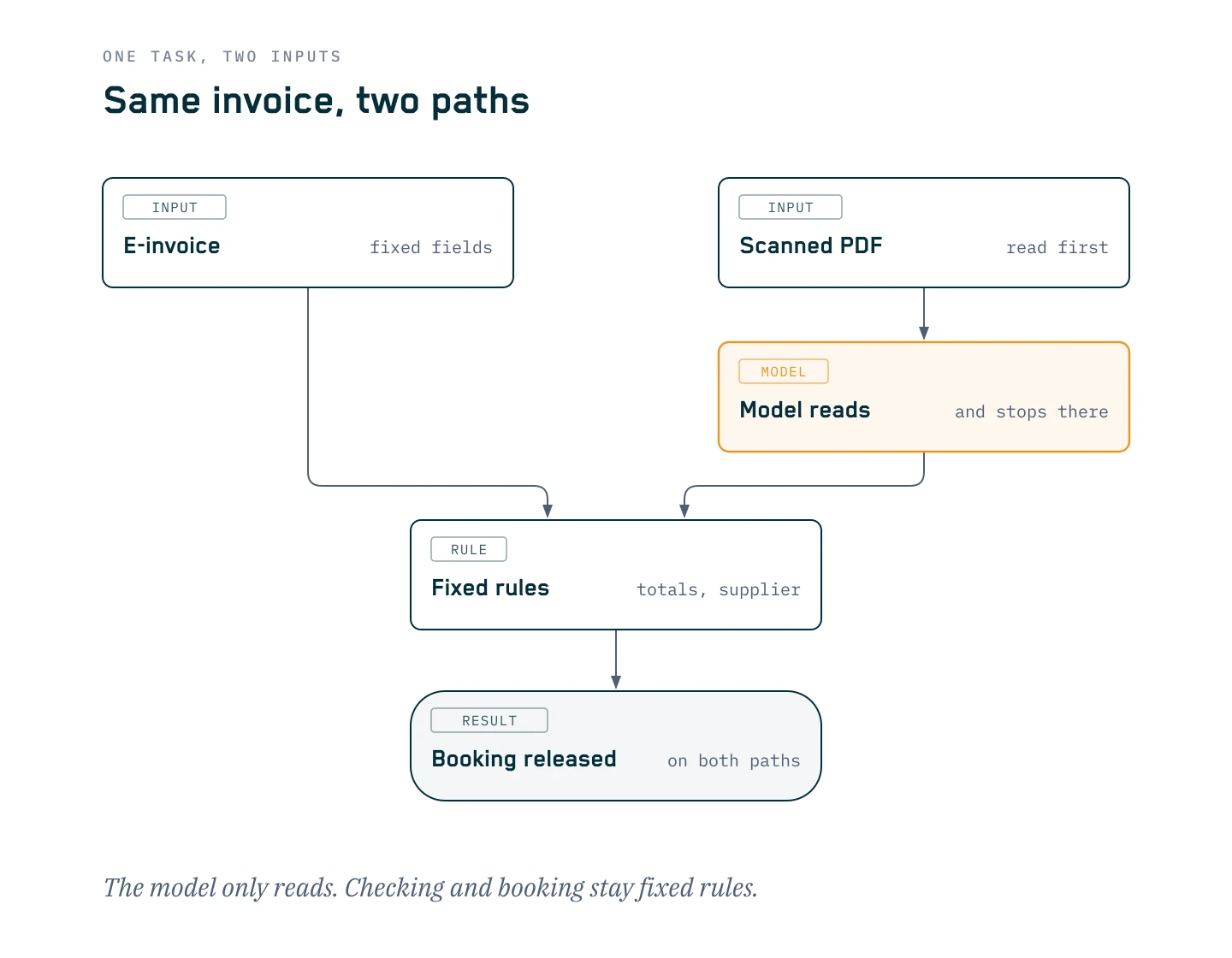
Fixed-rule (deterministic) means: the same input always leads to the same, traceable result. A model (probabilistic) weighs each case anew and may decide differently the second time.
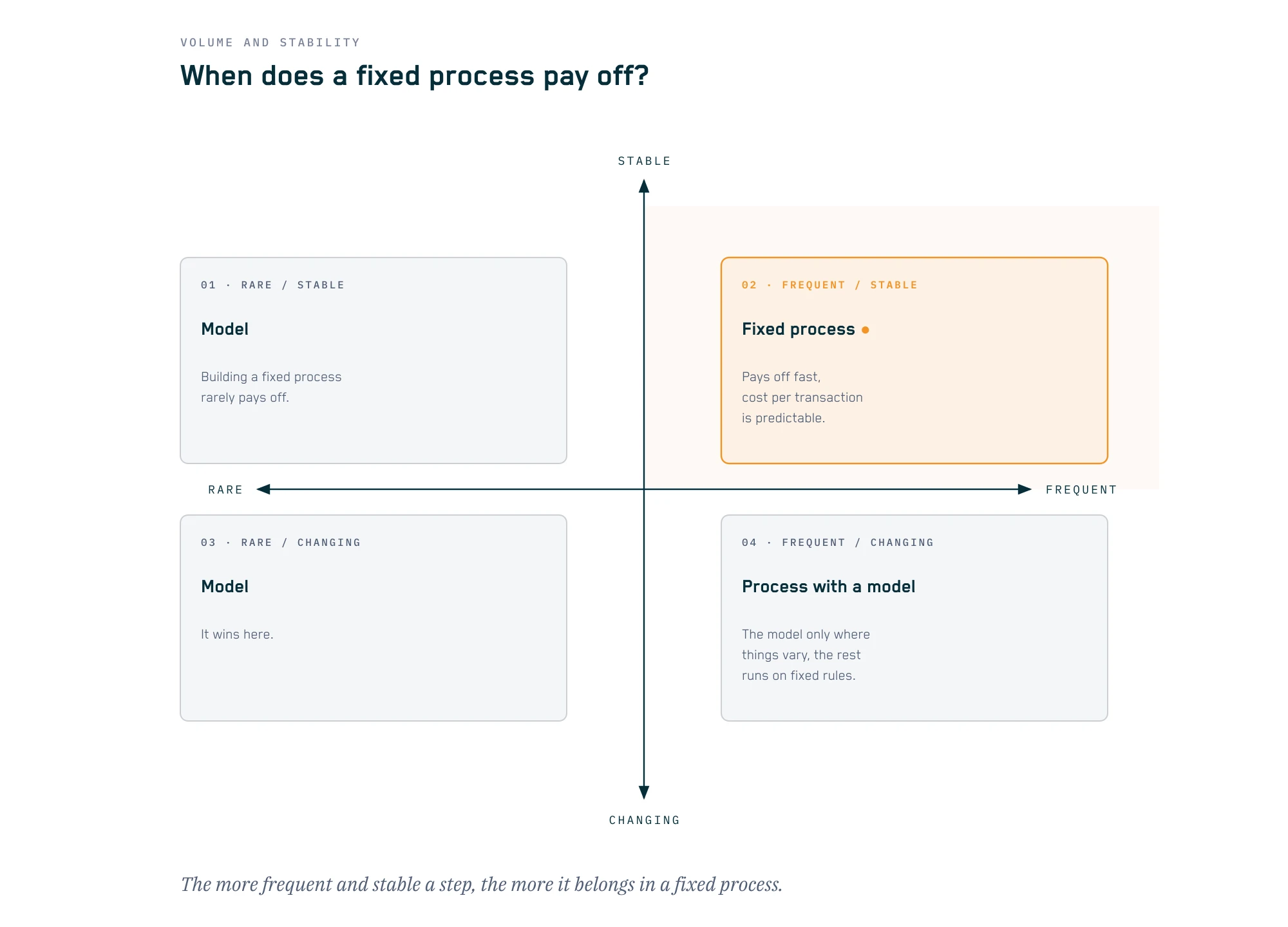
Whether a fixed process pays off depends on two things: how often the step occurs and how stable the requirements are. With high volume and stable requirements, the fixed process pays for itself quickly in my view. For rare or constantly changing tasks, the model often wins. On top of that comes the effort of checking, which a process has to bring from the start.
In our team we run this audit ourselves, and the value of the split is large for us. We want to move as much as possible into the rule-based area, and we have already converted a good deal.
Two examples from our training material. Whether the code examples in our materials still run with the current version of the tool used to be checked by hand. Today fixed tests that we designed with Claude Code check this automatically on every change. Errors surface immediately, not in front of customers. For updating diagrams we used to plan up to a day per training, and we drew sparingly accordingly. Because a diagram now costs little, 24 new ones were added to a single training in the latest revision. We keep variants side by side, pick the clearest, and drop whatever adds nothing. AI helps create the material; in the room only the result counts.
We built the diagram workflow with Claude Code as well. Day to day, both run largely without AI, and that is why they are fast, cheap and traceable.
Every conversion gets a metric up front: what a run costs, how early an error shows up, how long a pass takes. I recommend that for every AI program. If you define in advance what success looks like, you can show afterwards whether things got better. Otherwise "faster" stays a feeling. The wrong metric can even do harm. In a law firm observed by researchers from Stanford, Virginia and Dartmouth, paralegals using AI delivered more value on fewer cases, and the old measurement by case count no longer captured it. And anyone who counts token consumption rewards usage for its own sake, according to the same study.3 Anthropic, the maker of Claude, advises in its own guide to agents to start with the simplest solution and increase complexity only when needed.4
A model costs money on every run. A fixed process costs once to build and then in upkeep. For budget planning the main point is that the cost per run is easy to predict with a fixed process. With a model it depends on the model you choose: a practical guide to AI budgets calculates that the same session of five questions in the Copilot catalog can cost roughly 270 times as much depending on the model, and sees habit as the only reason to pick the expensive one.5
Internal audit, which needs to trace decisions, benefits too. With a fixed process you can show which rule produced a decision. With a model you can document the result, but the decision behind it only in part, and a second run can end differently.
The strongest objection to my line: models are getting cheaper, so why build processes? Total cost, however, consists of building, changing and checking, and the objection wins where a step is rare or its requirements change often. What remains open is whether models become so reliable that the gap in auditability shrinks. I do not plan on it today.
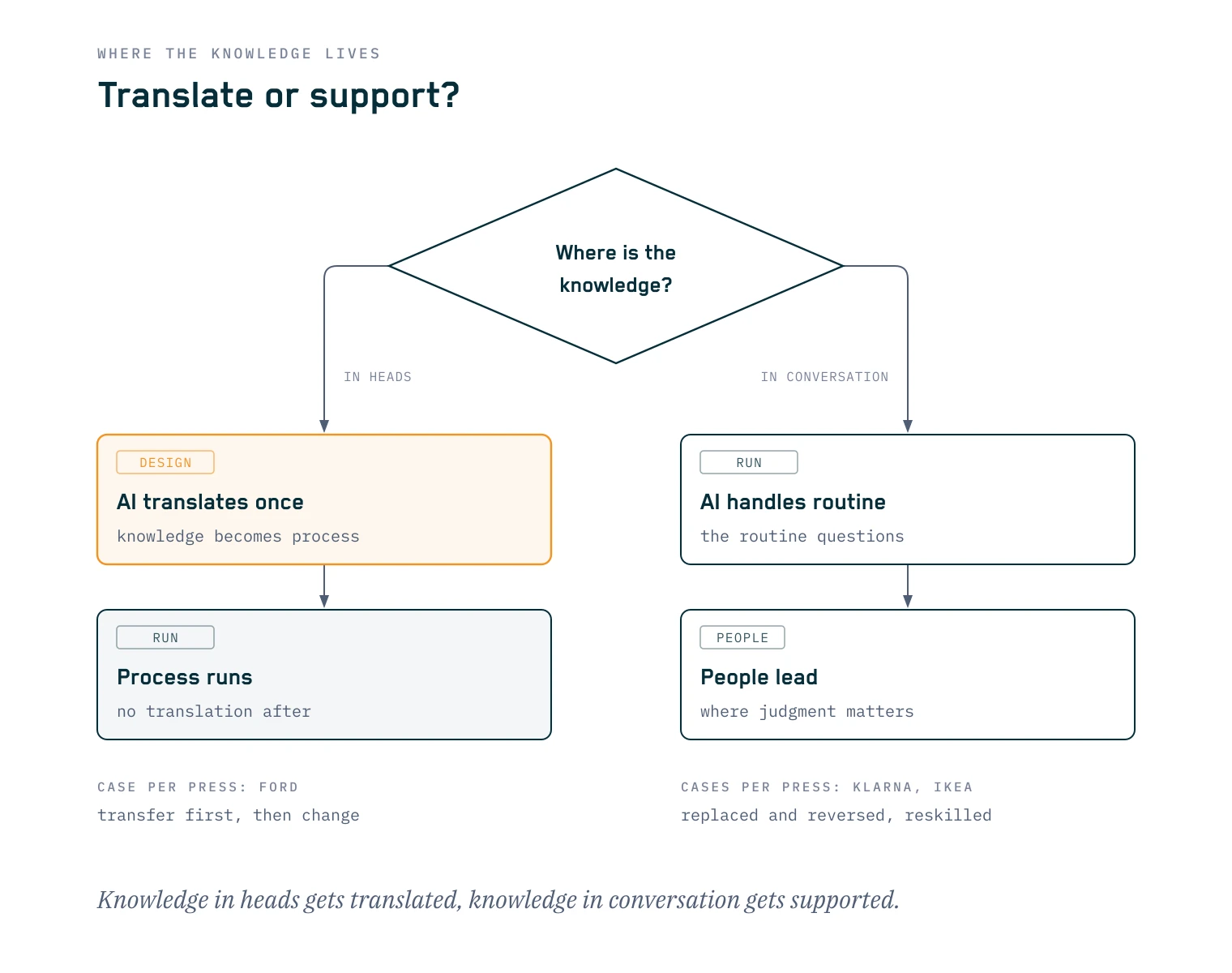
After cost, the question is which role AI gets in a step, and for me it depends on where the knowledge for that step lives. In recurring, rule-based work it sits in the heads of experienced people, for example in risk assessment and claims handling. Paulina Dubas calls this AI as a compiler: AI helps once to translate the knowledge into a fixed process, and after that the process runs.6 For that, the experienced people still have to be there. According to press reports (Bloomberg, TTNews), Ford let experienced quality engineers go before their knowledge had been transferred, and later brought them back.7 Here it pays to keep the order: transfer first, then change.
In customer service, by contrast, the knowledge is created in the conversation, and nobody knows what the next message will contain. Here AI stays in live operation as support: it catches the routine questions, and people lead the conversations where judgment matters. According to press reports, Klarna largely replaced support with AI and backed off after quality problems (Forbes, Entrepreneur), while IKEA had a chatbot absorb the routine and retrained staff as interior design advisers (PYMNTS).7 One question connects both cases: does the knowledge sit in heads that first have to be transferred, or is it created in a conversation that people carry on?
Someone has to build and maintain the fixed process, and that takes engineering. What happens to the funding when the dip arrives? The 2026 DORA report expects it: for AI adoption it describes a phase of falling productivity that it calls the "tuition cost of transformation", and it warns that stopping in the middle of the valley forfeits the return (here following InfoQ's report on the study).8
What happens without this investment is shown by a finding from Faros, a vendor of engineering analytics: in teams with high AI usage more got done, but at company level no effect was measurable, and according to Faros the backlog moved into review.9 For decision makers that means: accelerated individual steps cost AI budget and show little in the result as long as the process around them stays the same. The money belongs in the whole process and its bottlenecks, and that is why an audit has to deliver more than a list of the steps where AI could help.
The investment also includes prepared people. As early as 1983, Lisanne Bainbridge described how automation leaves people the exceptions that demand the most skill, while they practice less in normal operation.10 A clean process with few exceptions therefore calls for training for those exceptions.
As a design principle for decision makers, I keep one question that I ask first at every step: do we need a model here at all, or are we missing a process?
If the answer is "a model", four questions follow:
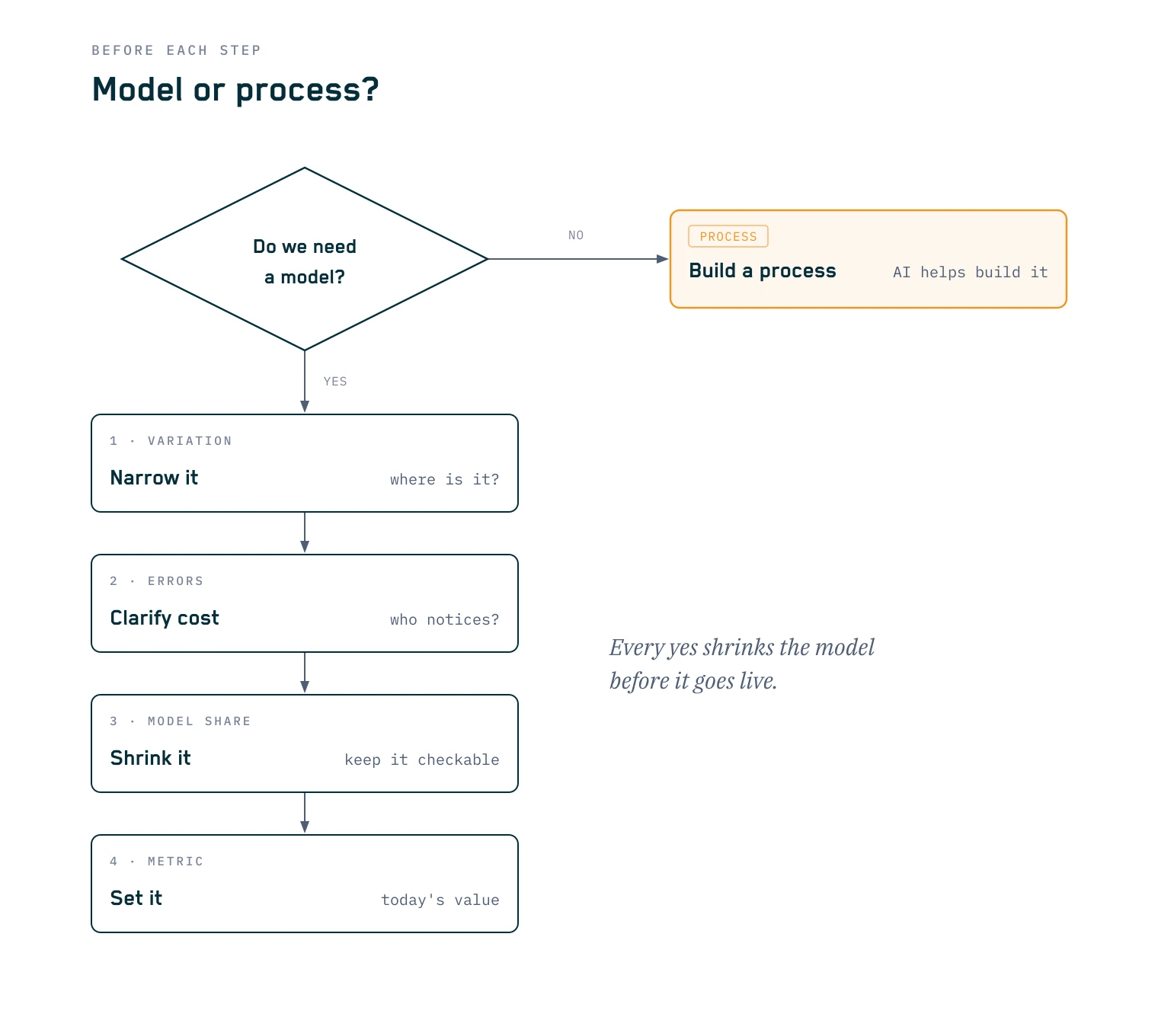
AI helps with answering: at our company Claude reads along with the processes and uncovers exceptions. Where the line runs and who is accountable for it, people with budget and liability decide.
The line between process and model is not fixed. In our experience, what needs a model today can often be turned into a fixed process after a few runs that went the same way. The audit is therefore a rhythm, not a one-off project. Where does the line run for you right now, and when did you last move it?
This question occupies us every day, with technical teams that build processes and with leadership teams that decide where the line runs. If you are about to start such an audit or are in the middle of one, we are glad to talk about what it could look like for you. You can find our offering at infralovers.com/courses, and the Enablement Team is the form in which we accompany teams through it.
The position is mine, and Claude helped with structuring and proofreading. The sources are listed below. I describe the full workflow in AI-Assisted Knowledge Work: How I Am Rebuilding My Research and Writing Process.
Michael Hammer (1990): Reengineering Work: Don't Automate, Obliterate. Harvard Business Review, July/August 1990. hbr.org ↩︎
Thomas H. Davenport (1995): The Fad That Forgot People. Fast Company. Davenport describes himself as one of the creators of reengineering; the assessment is his own account. Archive copy ↩︎
Dylan Walsh (2026): Want Employees to Embrace AI? Stop Selling It as a Productivity Tool. Stanford HAI, October 7, 2026; report on a field study by Karunakaran (Stanford), Raveendhran (University of Virginia) and Kim (Dartmouth). hai.stanford.edu ↩︎
Anthropic: Building Effective Agents (Schluntz and Zhang, December 2024). anthropic.com ↩︎
Jeffrey Monnette (2026): AI Credit Playbook, How to Slow Your Copilot Budget Burn. The chat example (0.0068 versus 1.85 dollars) comes from the article. LinkedIn ↩︎
Paulina Dubas (2026): Tokenmaxxing. LinkedIn article; "agents as the compiler, code as the runtime" is her wording. LinkedIn ↩︎
Press reports. Klarna: Forbes, Entrepreneur. IKEA: PYMNTS. Ford: Bloomberg, TTNews. ↩︎ ↩︎
InfoQ (2026): New DORA report claims strong engineering foundations decide AI ROI. Secondary report on the DORA report 2026. infoq.com ↩︎
Faros AI: The AI Productivity Paradox. Vendor finding based on its own telemetry; it compares teams with high and low AI usage. faros.ai ↩︎
Lisanne Bainbridge (1983): Ironies of Automation. Automatica 19(6). ↩︎
Picture the leadership team declaring AI First. Every department is told to go through its processes and mark where a model can help. A few weeks later a list
What does a driverless elevator have to do with the question of who still gets to become a senior in the age of AI? The first driverless elevator ran around
I wanted to find out whether our internal, VPN-only systems could be made usable from Claude, with real identity, and without the connection turning into a
Two weeks ago I wrote about what changes when you keep the model fixed and swap the harness. The short version: the wrapper matters more than people assume.
A web agency takes its clients from idea to finished website along the same path it used twenty years ago: a briefing becomes a concept, the concept becomes a
You are interested in our courses or you simply have a question that needs answering? You can contact us at anytime! We will do our best to answer all your questions.
Contact us