
Who Will Train the Seniors When the Juniors Are Gone?
What does a driverless elevator have to do with the question of who still gets to become a senior in the age of AI? The first driverless elevator ran around
What does a driverless elevator have to do with the question of who still gets to become a senior in the age of AI?
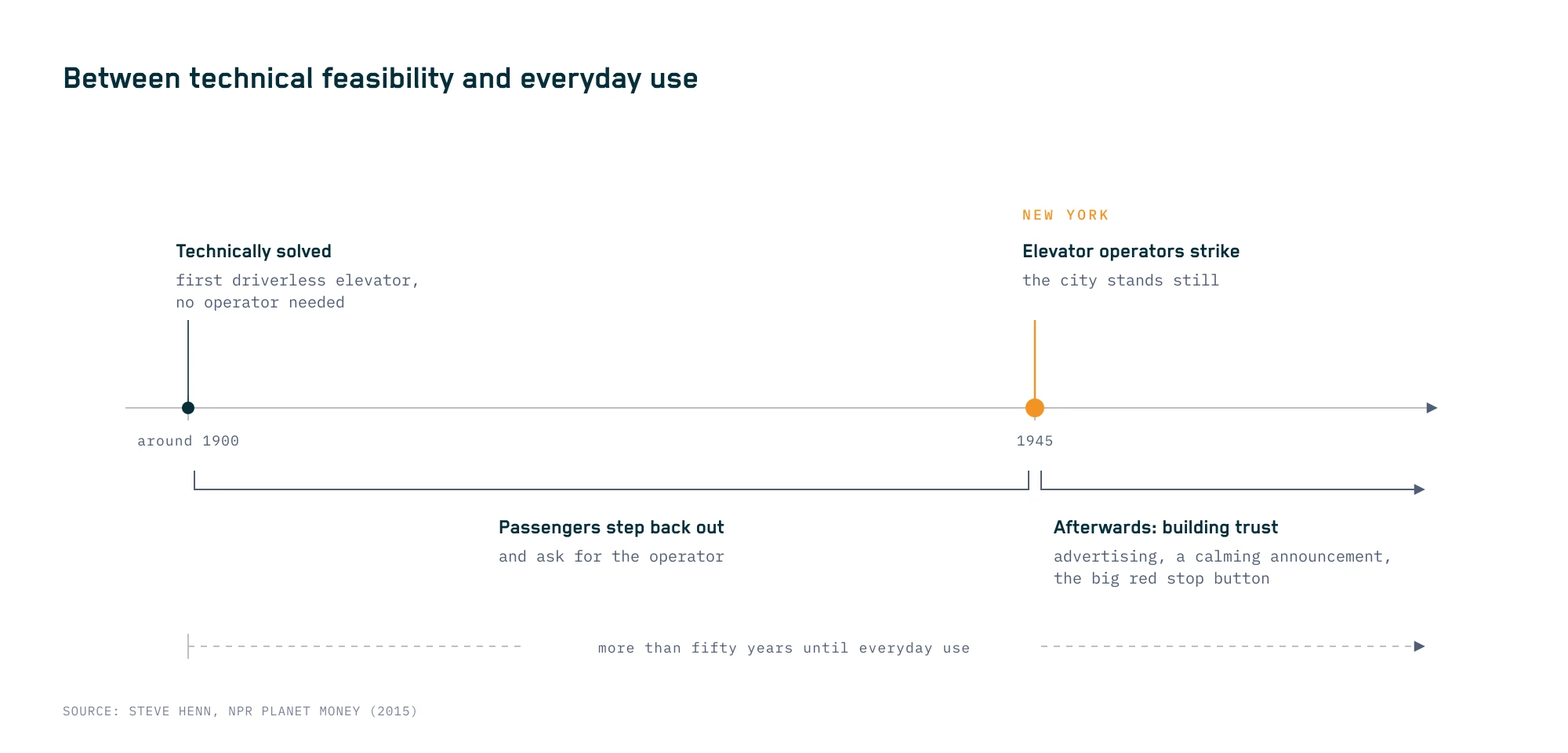
The first driverless elevator ran around 1900, with doors and safety rails that worked without an operator.1 The technology was solved before World War I even started. Passengers still stepped in, looked around, and stepped back out to ask for the elevator operator.1 It took more than fifty years before the automatic elevator became ordinary, and the trigger was not a technical breakthrough: in 1945, New York's elevator operators went on strike, the city ground to a halt, building owners demanded the switch, and the industry built trust systematically, with advertising, a reassuring voice announcement, and the big red stop button.1
The elevator operator is more than a charming footnote in the history of technology. James Bessen traced this for an NBER paper, checking what became of the 271 occupations the 1950 US Census tracked in detail.2 His finding: only one occupation disappeared largely because of automation, the elevator operators, as Bessen calls them.2 Sixty years of automation, and almost all of it was partial: a machine took over individual tasks, the occupation itself survived, sometimes it even grew. Even the ATM, the textbook example of displacement, coincided with a growing number of bank teller jobs, up 2 percent a year since 2000.2
That brings us to the forecasts coming out of the AI industry: Anthropic CEO Dario Amodei (many readers know Claude and probably work with it) predicted in 2025 that generative AI could eliminate half of all entry-level white-collar jobs within one to five years and push unemployment to 10 to 20 percent (quoted after 3). Humlum and Vestergaard set that claim against Daron Acemoglu's own model in the same paper, which expects annual productivity gains below 0.07 percentage points over the next decade, and they describe substantial disagreement between the two (quoted after 3).
Both forecasts can be true at once, because they measure different things: Amodei talks about employment, Acemoglu about productivity, and Acemoglu's number says nothing about entry-level jobs specifically. Seen that way, the juxtaposition is less a contradiction than an open question: which quantity should anyone even be forecasting for this technology?
For an organization that also has to decide on entry-level roles, this juxtaposition is not an academic question. Whether Amodei or Acemoglu turns out closer to right does not change the question that arises once entry-level work specifically is affected: if part of the tasks disappears that someone used to learn from incidentally, where does the judgment that defines a senior role come from in five or ten years? The answer does not start with a forecast. It starts with what is already measurable in 2026, and it leads to a conditional thesis:
If automation removes the tasks that used to teach incidentally, and no other learning path takes their place, an organization has to deliberately design the entry level as a place to learn.
Whether that happens becomes a question every organization has to answer for itself.
Before testing that question against one's own organization, it's worth a look at the forecasts themselves, because both leave open a question that matters more to a staffing decision than the metric they measure: why this particular window, one to five years in Amodei's case?
Here's a short detour to Simon Wardley. Wardley's Climatic Patterns, the predictable forces on a Wardley Map, give an uncomfortable but well-grounded answer:
"You cannot measure evolution over time or adoption."4
According to Wardley, a technology's evolution moves through multiple waves of diffusion, with plenty of gaps in between.4 A second pattern from the same collection fits the elevator case: the transition from product to utility typically happens as punctuated equilibrium, in jumps rather than a smooth curve.4 An event like a "war" can trigger forced industrialization, and it's that event, not a calendar date, that forces organizations to adapt.4 For the elevator, that point was the New York strike of 1945, not the technical breakthrough itself, which had happened fifty years earlier! Between technical feasibility and everyday use sat a long gap, eventually closed by the strike and the systematic trust-building that followed. A given year can still turn out right. But stating a year without a visible derivation from diffusion speed or a triggering event is a category error, and that is what Amodei's forecast does: at least in the form quoted, it names neither a mechanism nor data for the timeframe.
One could object that a diffusion pattern is too uncomfortable for workforce planning: anyone planning for 2027 eventually needs a number. That number just doesn't have to come from a calendar date. It can come from observation instead: what already shows up in an organization's own hiring numbers helps it make the next staffing decisions more reliably than a diffusion date would, and that is exactly what can already be measured for 2026.
And plenty got measured in 2026, with contradictory results. That's worth a closer look.
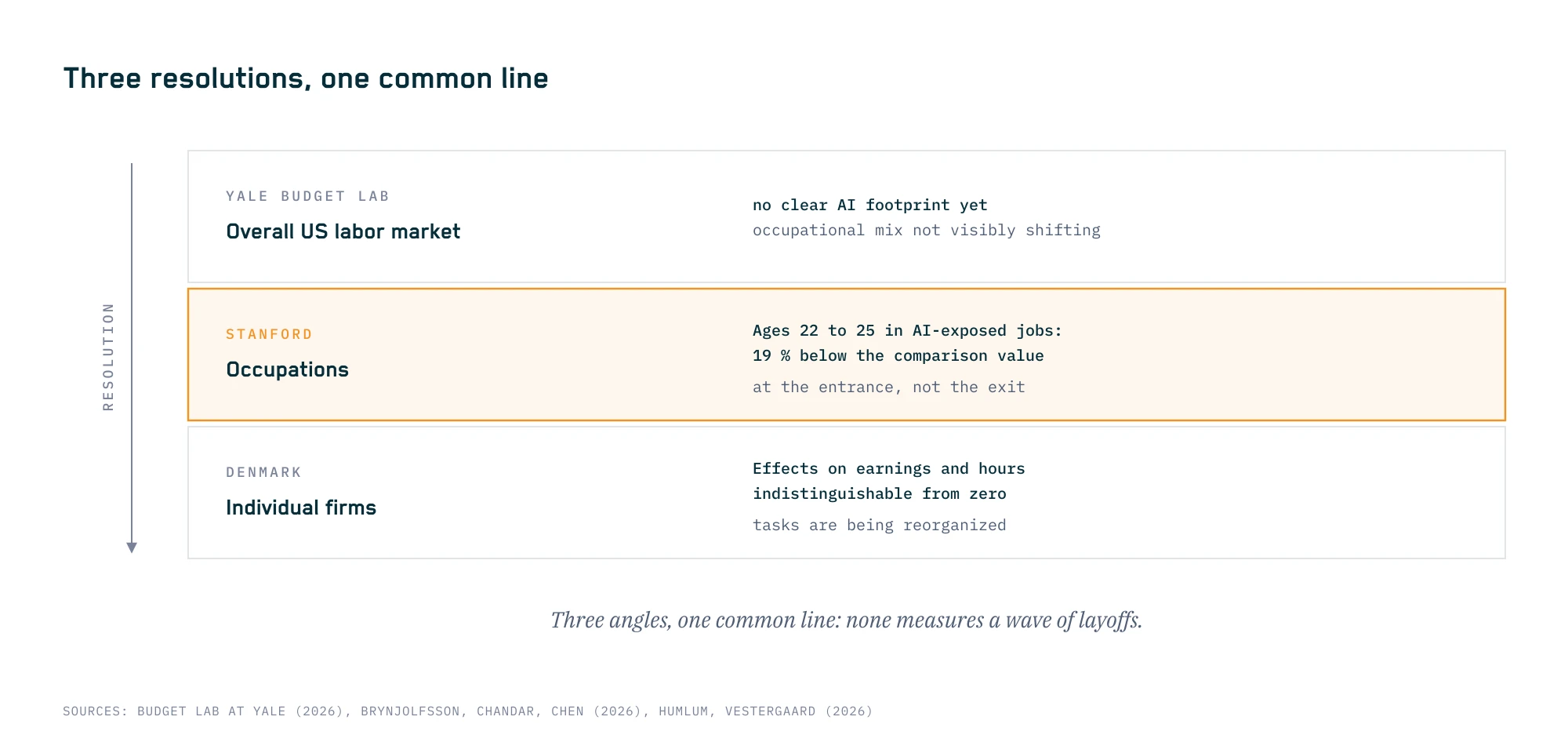
The decline shows up most clearly at Stanford: employment of 22- to 25-year-olds in AI-exposed occupations sits 19 percent below where it would be had it grown in step with their less-exposed peers.5 Experienced workers show no such gap, and the gap comes from fewer hires, not more layoffs: separation rates for young workers in the most exposed occupations fell by at least as much as in the least exposed ones, the opposite of what a layoff wave would predict.5 The study frames itself explicitly as "canaries in the coal mine," early warning indicators, with no claim to causation.5
The Danish study checks the same question from the other side. Instead of looking at the occupational mix overall, it looks at actual use inside individual firms, and that shifts the diagnosis: Anders Humlum and Emilie Vestergaard find effects on earnings and hours that are statistically indistinguishable from zero, even for daily heavy users.3 The decline among young workers shows up in Denmark too. But firms that actively adopt generative AI explain only a small part of it: an effect of chatbot adoption on the entry-level share larger than a third of a percentage point is ruled out, and even in the worst case, adoption explains at most just under a quarter of the entire decline.3 The rest stays unexplained.
What the Danish study doesn't look at: whether general hiring weakness after the rate turnaround and lingering pandemic effects plays a role too. Stanford, for its part, examined this rate exposure separately for its own divergence and finds only a limited explanatory role.5 What the Danish study does add: workers reorganize tasks on a large scale, with self-reported time savings around 3 percent of working hours, without that showing up in wages or hours so far.3 The authors call the pattern "still waters, rapid currents," a calm surface with a fast current underneath.3
At the aggregate US level, the third study, by the Budget Lab at Yale University, still finds no clear AI-driven footprint: the occupational mix shows no detectable shift, and measures of AI use don't correlate with changes in employment or unemployment, tracked continuously in a public dashboard.6 That doesn't refute the other two findings, it marks a boundary: a shift at the entry level within specific occupation groups can coexist with an overall labor market that still looks unremarkable, because the three studies measure different resolutions.
Three studies look at the same question from three different angles, and yet one line connects them: none of them measures a layoff wave. Stanford shows this most clearly: where the effect shows up, it shows up at the entrance, not the exit.5
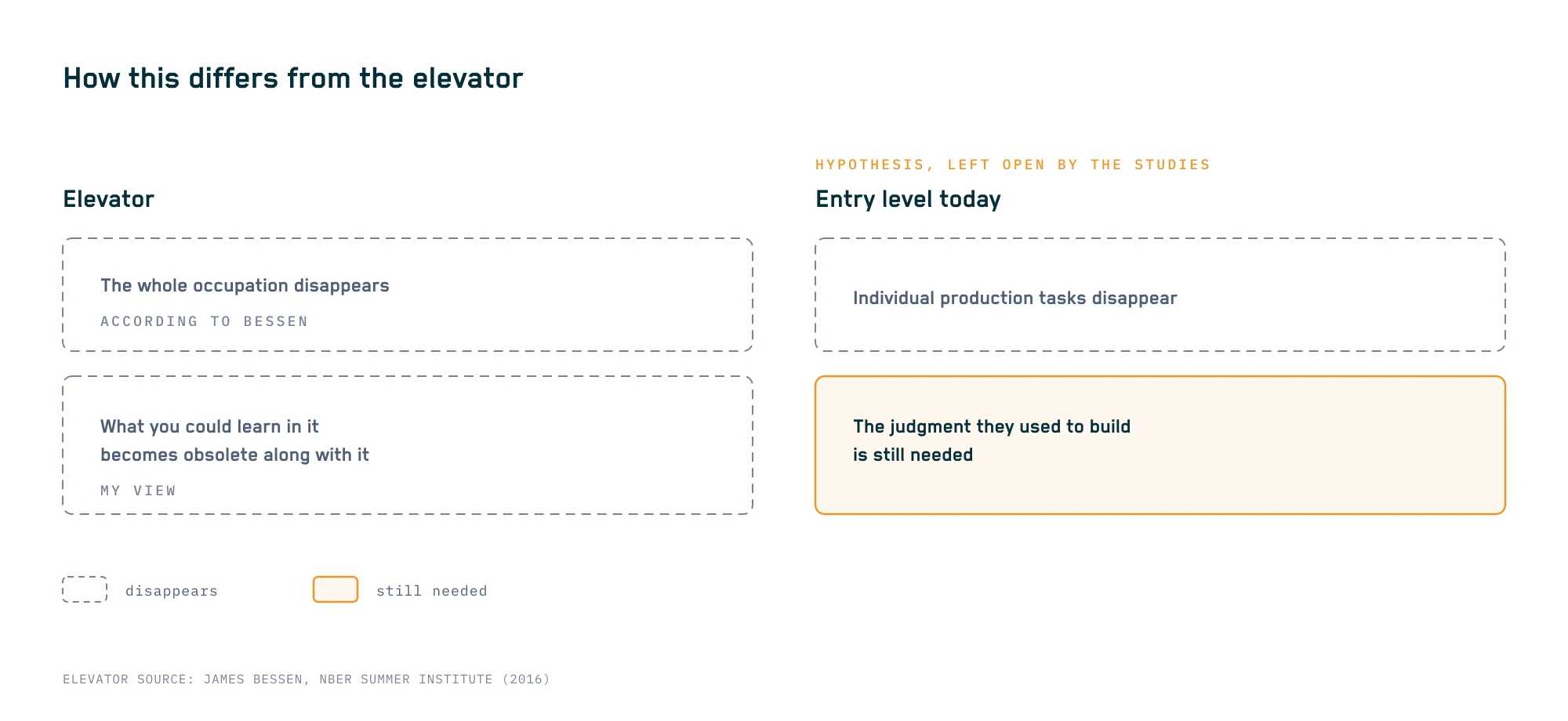
That entry-level work specifically is affected can be explained precisely by contrasting it with the elevator. At the elevator, according to Bessen, the entire occupation disappeared; whatever one could learn inside it became redundant along with it. Something different could be happening in today's entry-level roles: individual production tasks disappear while the judgment they used to contribute to remains needed. That's a hypothesis the studies themselves leave open: they show the decline, not reliably its cause. Bessen's central distinction still carries it: automation almost always hits individual tasks, rarely the whole occupation, and whether an occupation grows or shrinks under that pressure depends mostly on the elasticity of demand for its output, together with the question of which other occupation absorbs the work.2 At Stanford and in Denmark, the entry-level tiers under study consist of a bundle of well-defined, easily checkable tasks, in accounting, customer support, or clerical work, for instance.53 Whether that holds for entry-level roles in general is not something the studies show; they describe these occupation groups, not an overarching definition of entry level.
The Stanford study offers its own, cautiously worded evidence here: occupations with a high share of codified, formally documentable knowledge show slower employment growth at entry level, while occupations with a high share of tacit, experience-based knowledge show faster growth at mid- and late-career stages.5 The authors themselves flag this as "suggestive," not proof, and it's an employment pattern, not a statement about what's technically automatable: the study measures who gets hired, not which tasks a machine can take over.5
Bessen's own finding carries a tension he discloses himself: the same partial automation that makes a task cheaper can actually increase demand for the whole occupation, if demand reacts elastically enough. With the ATM, cheaper branches led to more branches, and more branches led to more teller jobs.2
Cheaper entry-level work could, in theory, generate more demand rather than displacing it. The studies only measure two to three and a half years after the broad rollout of generative chatbots, and whether that window is long enough to already see such a reaction is an open question.
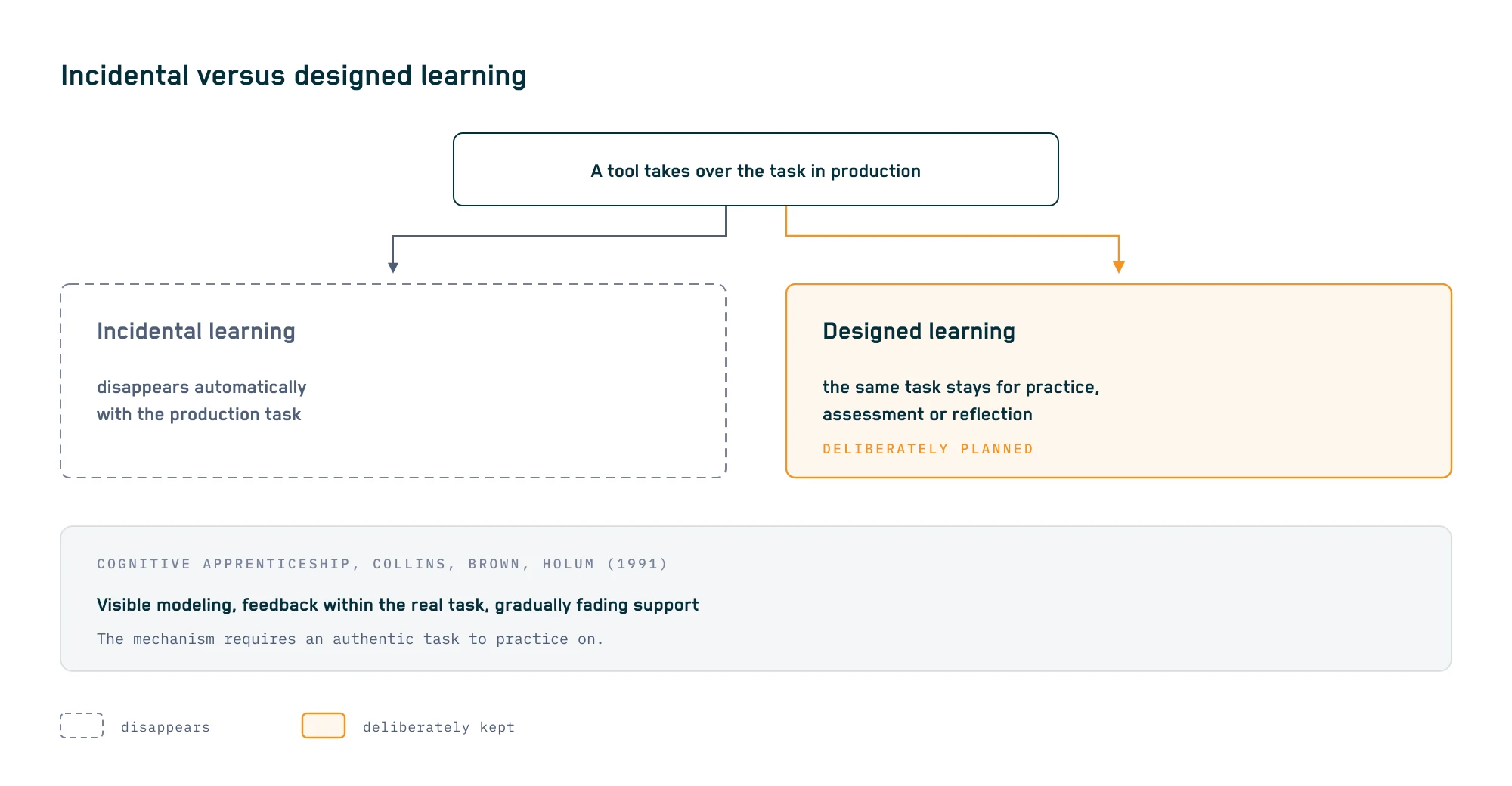
This question is older than generative AI: the Cognitive Apprenticeship teaching model has argued since the early 1990s that expertise develops mainly through visible modeling, feedback inside a real task, and support that fades out step by step, less through facts alone.7 The mechanism depends on an authentic task to practice on. When a tool takes that task over in production, that doesn't automatically mean it disappears as a learning opportunity: the same task can still be used for practice, assessment, or reflection, if an organization plans for that deliberately. That's the difference between an incidental learning spot, which vanishes automatically along with the production task, and a designed learning spot, which is kept around on purpose.
That's a conditional risk to training. What happens if the mechanism above holds and the remaining tasks can't be deliberately used for practice? A plausible counter-hypothesis, equally unmeasured: AI could change or accelerate skill-building rather than hinder it, if simulations, deliberately induced incidents, or supervised delegation took the place where real mistakes used to carry the learning. In principle, the two could be told apart by whether organizations that deliberately redesign the entry level reach reliable judgment in new hires about as fast as before in a few years, or more slowly.
That won't be measurable for a while, and it has a parallel in the elevator story itself: operating an elevator cost a learning spot too, just one nobody misses today, because the task behind it is gone completely, the skill of bringing a cabin exactly level with the floor. For accounting, customer support, and clerical work, the occupation groups Stanford and Denmark study, the case is different: the task above it, the one that calls for judgment, remains and tends to grow more important rather than less. Only the path toward it, through smaller, checkable intermediate steps, might narrow, unless organizations keep it open deliberately.
For organizations, that means the entry level is not a cost line to cut prematurely just because a tool handles its tasks faster. It is a learning environment that has to be actively designed, once it no longer emerges on its own as a byproduct of everyday work.
Does an organization even still need today's form of the entry level, if generative AI shortens the learning curve itself? If so, the classic entry level wouldn't be broken, it would have become unnecessary, and the right response would be to redesign the entry level rather than repair it.
The difference between repairing and rebuilding hinges on a question nobody has answered yet: how much of today's entry-level role consists of pure service work, tasks like the elevator operator's that can vanish without a trace, and how much consists of the learning opportunity that a later senior role rests on. For elevator operation it was almost entirely the first: a skill nobody needs anymore, because the task itself is gone. These entry-level occupation groups are probably a mix of both, and that mix is one of the conditions that decides whether an organization has to repair or rebuild.
That split can't be estimated from a desk. It shows up once an organization deliberately turns one of its remaining entry-level tasks into a learning spot and watches what judgment develops there, and how fast.
In the end, one question remains that no forecast can answer, only observation inside one's own organization: which of the automated tasks were also important learning opportunities, and what replaces them once they're gone? That's one of the aspects we factor in when we build and run Enablement Teams.
If this mechanism holds and no other learning path emerges, the person missing in a few years might be the one who's still learning today in accounting, customer support, or clerical work: the experienced professional who decides edge cases, takes responsibility, and can judge the work of both people and agents, a role nobody has to fill yet today. The bottleneck would then no longer show up at the entry level. It would show up exactly where it's most expensive, and that's what we like to talk about before it gets there: through our Enablement Team, or just reach out via contact.
This piece rests on five primary sources: James Bessen's NBER paper on computer automation, the Stanford working paper on "Canaries in the Coal Mine," the Danish register study by Humlum and Vestergaard, the Yale Budget Lab tracker, and the Collins, Brown, and Holum essay on Cognitive Apprenticeship, plus two secondary sources: the NPR piece on elevator operators and Ben Mosior's write-up of Wardley's Climatic Patterns. I cite the Amodei and Acemoglu forecasts the way Humlum and Vestergaard contrast them in their paper, not from the originals. I read the linked sources at their original URLs and then filed them in our internal knowledge wiki. Research structure and, this time, around five drafts of the piece came together with AI assistance; the numbers and quotes come from the linked primary sources and were checked against them before publication, and so was the argument itself, against an adversarial second read (I describe the full process in AI-Assisted Knowledge Work: How I Am Rebuilding My Research and Writing Process (in German)).
Steve Henn (2015). Remembering When Driverless Elevators Drew Skepticism. NPR Planet Money. npr.org/2015/07/31/427990392 ↩︎ ↩︎ ↩︎
James Bessen (2016). How Computer Automation Affects Occupations: Technology, Jobs, and Skills. NBER Summer Institute. conference.nber.org/confer/2016/SI2016/PRIT/Bessen.pdf ↩︎ ↩︎ ↩︎ ↩︎ ↩︎
Anders Humlum, Emilie Vestergaard (revised March 2026). Still Waters, Rapid Currents: Early Labor Market Transformation under Generative AI. NBER Working Paper w33777. Measured among more than 25,000 surveyed workers in eleven heavily exposed occupations, linked to register data from Statistics Denmark. nber.org/system/files/working_papers/w33777/w33777.pdf ↩︎ ↩︎ ↩︎ ↩︎ ↩︎ ↩︎ ↩︎
Ben Mosior (2021). Climatic Patterns. Learn Wardley Mapping. learnwardleymapping.com/climate ↩︎ ↩︎ ↩︎ ↩︎
Erik Brynjolfsson, Bharat Chandar, Ruyu Chen (revised August 2026). Canaries in the Coal Mine? Six Facts about the Recent Employment Effects of Artificial Intelligence. Stanford Digital Economy Lab. Measured using ADP payroll data from several million employees per month, updated through June 2026; controlling for education shrinks the estimate noticeably, and a broader official survey shows a smaller gap than the payroll data. digitaleconomy.stanford.edu ↩︎ ↩︎ ↩︎ ↩︎ ↩︎ ↩︎ ↩︎ ↩︎
The Budget Lab at Yale (published 2026-07-16, updated 2026-09-15). Tracking the Impact of AI on the Labor Market. budgetlab.yale.edu/research/tracking-impact-ai-labor-market ↩︎
Allan Collins, John Seely Brown, Ann Holum (1991). Cognitive Apprenticeship: Making Thinking Visible. American Educator, 15(3), 6-11, 38-46. aft.org/ae/winter1991/collins_brown_holum ↩︎
What does a driverless elevator have to do with the question of who still gets to become a senior in the age of AI? The first driverless elevator ran around
I wanted to find out whether our internal, VPN-only systems could be made usable from Claude, with real identity, and without the connection turning into a
Two weeks ago I wrote about what changes when you keep the model fixed and swap the harness. The short version: the wrapper matters more than people assume.
A web agency takes its clients from idea to finished website along the same path it used twenty years ago: a briefing becomes a concept, the concept becomes a
I ran the same coding task through four AI coding tools this week - opencode, Pi, GitHub Copilot in VS Code, and Claude Code - all driven by the same local
You are interested in our courses or you simply have a question that needs answering? You can contact us at anytime! We will do our best to answer all your questions.
Contact us